Goldratt Wrote a Novel to Teach TOC. I Used TOC to Publish a Novel.
Edwin Navarro Bula
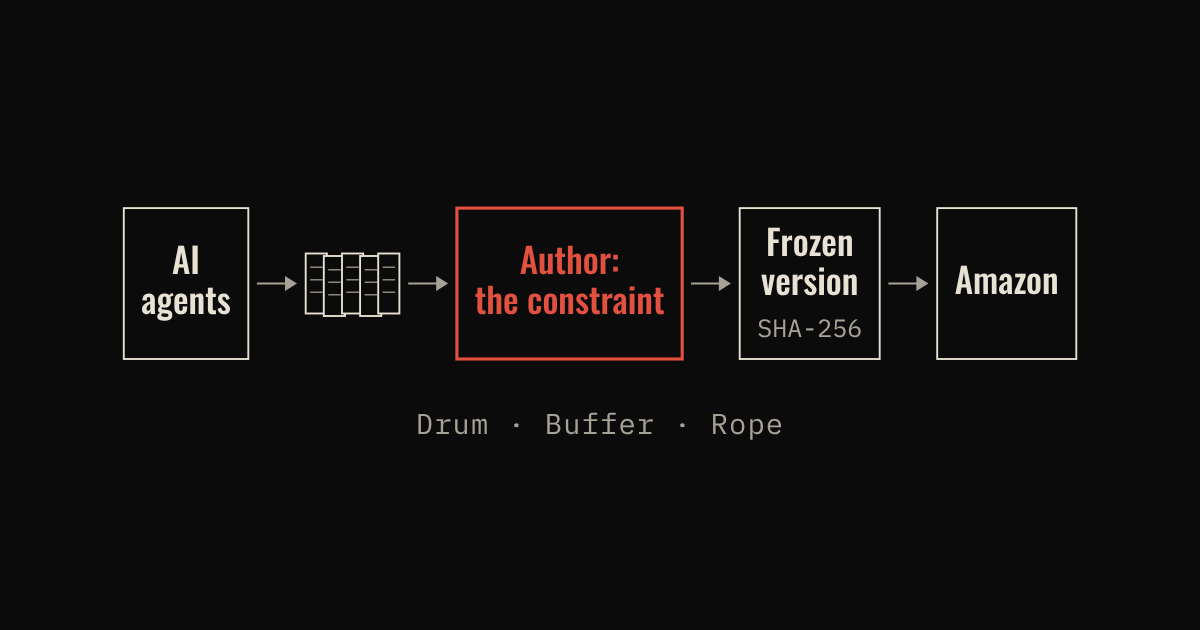
In 1984, Eliyahu Goldratt used a novel, The Goal, to teach the Theory of Constraints. This year I went the other way: I used the Theory of Constraints to take a novel to publication.
The result can be verified. CODICIA: Deuda de sangre, a 70,298-word Colombian medical technothriller, has been on Amazon since November 4, 2026. I managed it the way I manage a supply chain: a system with a single constraint, a flow to protect, and a pace set by whoever makes the decisions.
Before going any further, a disclosure. The story comes from a screenplay I wrote myself: idea, characters, acts, scenes, and dialogue. The novel's prose was written by AI agents (Claude) under my direction, and that is how it is disclosed on Amazon: AI-generated text and images. My job was to design the system, make the decisions, and verify every deliverable. This article is about that system.
Step 1. Identify the constraint
Intuition says the constraint in a novel is the writing. With AI agents, that's no longer true: producing a chapter takes minutes. What doesn't scale is the author's judgment and attention: deciding what the story keeps, spotting an inconsistency, approving or rejecting.
It's the same mistake we see on the plant floor when capacity is bought for the wrong resource. More generated text didn't take a single day off the schedule; it only made the queue in front of my desk longer.
Step 2. Exploit the constraint
If the constraint is my attention, every minute of it is worth what the whole system produces. The rule was simple: I decide and verify; the agents produce. Nothing an agent could prepare reached me unprepared. Every decision arrived with options already weighed, including a contrarian one, and a recommendation with its reasoning. I confirmed or changed it. My time stopped going into drafting and went into judging.
Step 3. Subordinate everything else
This is where most of the work is, just as in a real implementation. Subordinating meant three rules:
- One step at a time. No agent moved on to the next stage without approval of the previous one.
- Assignments with fixed acceptance criteria: what goes in, what comes out, and what counts as done. An ambiguous assignment is work-in-process in disguise.
- A single decision log for all the agents, checked before producing anything. If a task clashed with an active decision, it stopped and came back to me.
The agents had idle capacity almost all the time. That was fine: it was the price of not flooding the constraint.
Step 4. Elevate the constraint
Elevating didn't mean working longer hours. It meant freeing my attention from whatever a machine verifies better than a person:
- Every version of the manuscript was locked with a SHA-256 hash. If the hash didn't match, the file wasn't the approved one.
- Counts, comparisons between versions, and format validations were done with scripts, never by eye. The final file was checked against the frozen version: 1,208 of 1,208 paragraphs identical.
- Where no script was possible, targeted sampling instead of a full reread.
My attention was reserved for what only the author can judge.
Step 5. Go back to Step 1 without letting inertia become the constraint
The constraint moved twice. First, from writing to verifying: once producing was no longer scarce, the queue formed in front of review. Then, at publication, it left the system: today the constraint is the market, the readers who don't know the book yet. Each move forced me to change rules that had worked. Goldratt warned about this in his fifth focusing step: inertia is the hardest constraint to see.
Drum-Buffer-Rope
- Drum: my decisions. The project's pace wasn't set by how fast the agents worked, but by the cadence at which I could make good decisions.
- Buffer: the decision log and the frozen versions. They protected the drum from what the agents forget between one conversation and the next. When an agent started from scratch, the buffer brought it back to the approved state without using up my attention.
- Rope: no step was released until the previous one was approved. That way, no work piled up only to be undone later.
There were days when the rope seemed slow. In a supply chain, we'd say the same about disciplined order release: it feels slow until you compare it with the rework it prevents.
Bringing it back to the supply chain
The lesson isn't literary. When the capacity to produce becomes almost free—automated planning, generated forecasts, orders suggested by a system—the constraint moves to the judgment of whoever approves. If that judgment isn't protected with a buffer and a rope, the system fills up with unreviewed proposals, which is the work-in-process of our time.
The question for our implementations is no longer just where the physical bottleneck is. It's how much human judgment each decision consumes, and how much of that judgment we can turn into an automated check to give time back to the constraint.
In closing
CODICIA: Deuda de sangre is on Amazon, in Spanish. If you want to see the result of this system, you'll find the book and a sample chapter at edwinnavarrobula.com.